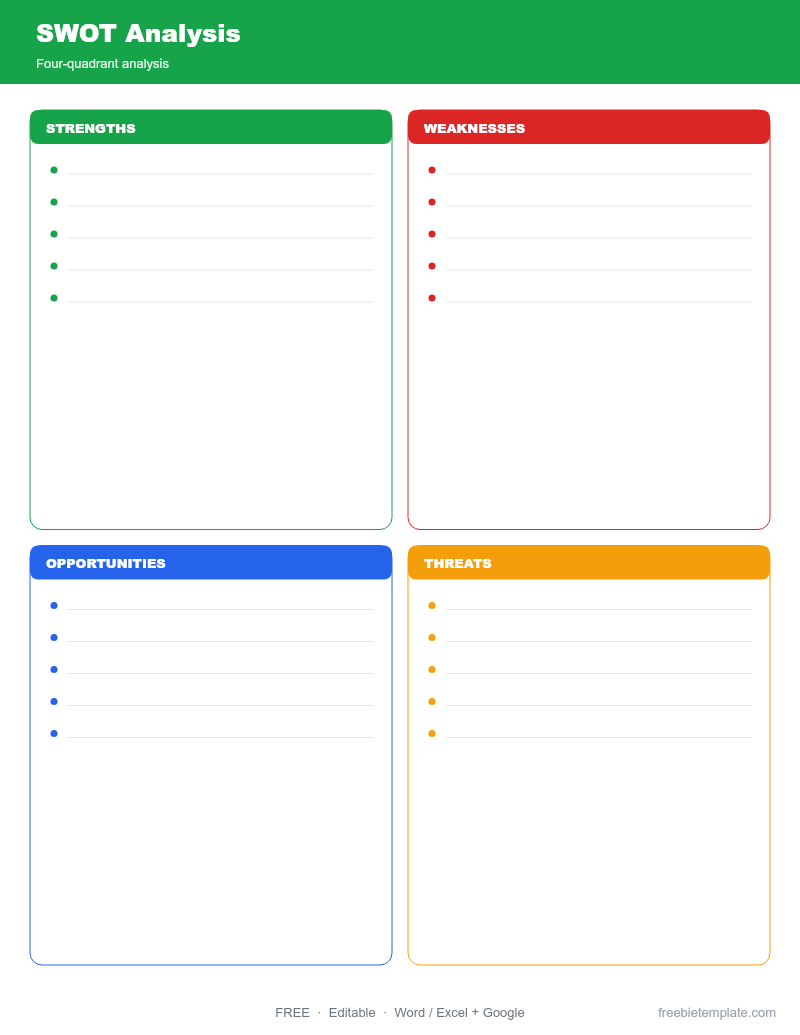
Free SWOT Analysis Template
Strengths, weaknesses, opportunities, threats.
Save this file straight to your Drive, then open it with Google Docs — no download needed.
- ✓Four-quadrant grid
- ✓Example prompts
- ✓Action items
About this template
A SWOT analysis maps your Strengths, Weaknesses, Opportunities, and Threats onto a single page so a team can see a situation clearly and decide what to do. Strengths and weaknesses are internal — things you control; opportunities and threats are external — things in the market around you.
This free template gives you a clean four-quadrant grid with example prompts in each box and an action-items row underneath, so the analysis ends in decisions instead of a wall of sticky notes. Use it for a business, a product launch, a marketing plan, or a personal career review.
What's included
- A balanced four-quadrant grid — Strengths, Weaknesses, Opportunities, Threats
- Example prompt questions in each quadrant to get the team unstuck
- An action-items synthesis row to turn the grid into next steps
- Clean layout that prints on one page for workshops
- Editable in Word — recolor or rebrand it freely
How to use it
- Frame the question. Decide exactly what you are analyzing — the whole business, one product, a campaign, or a decision. A focused SWOT beats a vague one.
- Fill the internal boxes first. Strengths and weaknesses are about you: skills, costs, brand, team, cash. Be honest — an inflated strengths box is useless.
- Fill the external boxes. Opportunities and threats are about the market: trends, competitors, regulation, new channels. Use the prompts if the team stalls.
- Convert it to action. For each quadrant, ask: how do we use a strength, fix a weakness, seize an opportunity, or defend a threat? Write the answers in the action-items row.
License: Free for personal and commercial use. No attribution required. Do not resell the template itself.
Frequently asked questions
What does SWOT stand for?
Strengths, Weaknesses, Opportunities, and Threats. Strengths and weaknesses are internal factors you control; opportunities and threats are external factors in your market.
How do you write a SWOT analysis?
Define what you are analyzing, then fill each quadrant honestly — internal strengths and weaknesses first, then external opportunities and threats. Finish by turning the boxes into concrete action items.
What is the difference between internal and external factors?
Internal factors (strengths, weaknesses) are things inside your control — your team, costs, and capabilities. External factors (opportunities, threats) come from outside — market trends, competitors, and regulation.
Can I use this SWOT template for personal or career planning?
Yes. A personal SWOT works the same way: strengths and weaknesses are your skills and gaps, opportunities and threats are the job market and competition around you.
Is the template free and editable?
Yes — it is a free Word document you can edit, recolor, and rebrand for personal or commercial use, with no signup or watermark.